
TLIF Surgery In Bhopal | Advanced Evaluation And Surgical Care For Lumbar Spine Conditions
Ongoing back pain can affect your work, sleep, travel, exercise, and daily routine. When pain spreads from your lower back into your buttock or leg, it may indicate irritation or compression of a lumbar nerve. You may also experience numbness, tingling, or muscle weakness. Patients looking for TLIF Surgery in Bhopal can consult Dr. Ritesh Nawkhare for a detailed lumbar spine evaluation. He carefully examines your symptoms and identifies the possible cause of your discomfort. During the consultation, Dr. Nawkhare reviews your medical history, previous treatments, neurological examination, and relevant MRI or CT findings. He also checks your spinal movement, muscle strength, reflexes, and nerve function. By comparing these findings, he determines whether non-surgical treatment may help or whether you may need a procedure such as TLIF.
Understanding Your Lower Back Problem
Back pain can develop for several reasons. A disc problem, nerve compression, spinal instability, degeneration, or changes in spinal alignment can cause similar symptoms. You may feel pain mainly in your lower back, or the discomfort may spread into your buttock, thigh, calf, or foot. In addition, nerve irritation can cause numbness, tingling, or muscle weakness.
Dr. Ritesh Nawkhare carefully evaluates the complete pattern of your symptoms. During your consultation, he asks when the pain started, what makes it better or worse, and how it affects your walking, work, and daily activities. He also checks whether previous treatment provided relief.
Reviews your medical history and previous treatment.
Examines your spinal movement and posture.
Checks muscle strength, reflexes, and nerve function.
Evaluates pain that spreads into your legs.
Studies relevant MRI, CT, or X-ray findings.
Identifies possible disc problems, nerve compression, or spinal instability.
What Is TLIF Surgery in Bhopal ?
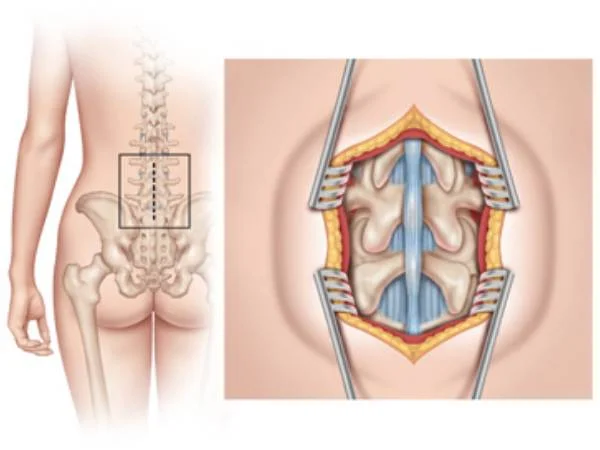
TLIF stands for Transforaminal Lumbar Interbody Fusion. It is a spinal fusion procedure that helps stabilise a specific level of the lower spine when structural problems require surgical treatment. During TLIF surgery, the surgeon reaches the affected spinal level through the back using a transforaminal approach. The damaged disc is removed, and an interbody implant is placed in the disc space. The surgeon may also use bone graft material to support the fusion process. In addition, screws and rods hold the treated vertebrae in position while the bones gradually fuse. When a spinal nerve faces compression, the surgeon may perform decompression to create more space around the affected nerve. This step aims to reduce pressure on the nerve and address related symptoms, such as radiating leg pain, numbness, or tingling. The surgical plan varies according to your diagnosis, affected spinal level, anatomy, symptoms, and overall health.
When May TLIF Be Recommended?
Dr. Ritesh Nawkhare may consider TLIF when a lumbar spine condition causes instability, nerve-related symptoms, or structural problems that continue despite appropriate non-surgical treatment. He first identifies the underlying problem and evaluates how it affects your spinal stability and daily activities.
He may recommend TLIF for selected conditions such as:
Lumbar spondylolisthesis: When one vertebra slips over another and causes instability or nerve irritation.
Spinal instability: When abnormal movement between vertebrae contributes to pain or nerve compression.
Degenerative disc disease: When disc damage contributes to persistent symptoms and spinal instability.
Selected recurrent disc problems: When repeated disc problems occur alongside instability or other structural changes.
Foraminal narrowing: When narrowed nerve openings cause compression and the condition also requires spinal stabilisation.
Certain lumbar spine deformities: When structural changes affect spinal balance or stability.
Conditions requiring nerve decompression: When the surgeon needs to relieve nerve pressure and stabilise the affected spinal level.
Symptoms That Should Not Be Ignored
Back pain may improve with simple treatment. However, persistent or worsening symptoms that affect your movement or daily activities may require a detailed spine evaluation.
You may need an evaluation if you have:
▪ Persistent lower back pain
▪ Pain spreading into the buttock or leg
▪ Tingling, burning, or pins-and-needles sensations
▪ Numbness or weakness in the leg or foot
▪ Difficulty standing or walking for long periods
▪ Repeated episodes of severe back or leg pain
▪ Symptoms that continue despite previous treatment
Dr. Ritesh Nawkhare reviews your symptoms, neurological examination, and relevant imaging to identify possible nerve or spinal problems and determine the appropriate treatment.
Why Does Pain Travel Into The Leg?
The nerves supplying your legs pass through the lumbar spine. Disc problems, joint changes, or surrounding tissue can irritate or compress these nerves.
Nerve irritation may cause pain to travel from your lower back into the buttock, thigh, calf, or foot. You may also experience tingling, numbness, burning, or weakness.
Dr. Ritesh Nawkhare assesses your symptoms, neurological examination, and relevant MRI or CT findings to identify the likely cause and determine the appropriate treatment.
Evaluation Before TLIF Surgery in Bhopal
Before recommending TLIF, Dr. Ritesh Nawkhare evaluates your symptoms and identifies the underlying lumbar spine problem.
Your evaluation may include:
▪ Reviewing your symptoms, medical history, and previous treatment
▪ Checking muscle strength, sensation, reflexes, and pain patterns
▪ Assessing your walking and movement
▪ Performing a neurological examination
▪ Reviewing relevant MRI or CT scans
▪ Ordering additional tests when required
This assessment helps Dr. Ritesh Nawkhare determine whether you need non-surgical treatment, monitoring, or surgery such as TLIF.
Your MRI Is Important, But It Is Not The Whole Diagnosis
An MRI can show disc degeneration, spinal narrowing, instability, structural changes, and nerve compression. However, these findings do not always explain your symptoms.
Dr. Ritesh Nawkhare compares your MRI with your symptoms, medical history, neurological examination, and previous treatment. He checks whether the scan findings match your pain, numbness, weakness, or other symptoms. This complete assessment helps him decide whether you need non-surgical treatment, monitoring, or surgery such as TLIF. He recommends TLIF only when your clinical findings and imaging support the need for surgical treatment.
Can Back Pain Improve Without Surgery?
Yes. Many lumbar spine conditions can improve with appropriate non-surgical treatment. Dr. Ritesh Nawkhare considers your symptoms, underlying condition, and response to treatment before recommending surgery.
Non-surgical care may include:
▪ Medicines for pain and related symptoms
▪ Physiotherapy and rehabilitation
▪ Activity modification
▪ Monitoring symptoms and neurological function
▪ Further investigations when required
If these measures provide adequate improvement, spinal fusion may not be necessary. TLIF may be considered when persistent symptoms, spinal instability, nerve compression, and imaging findings support the need for surgical stabilization.
When Is Surgery Considered?
TLIF may be considered when a lumbar spine problem causes persistent symptoms, spinal instability, or nerve compression despite appropriate non-surgical treatment.
Factors may include:
▪ Persistent back or leg pain despite treatment
▪ Lumbar spinal instability
▪ Symptomatic spondylolisthesis
▪ Nerve compression caused by a structural problem
▪ Selected cases of significant spinal degeneration
▪ Recurrent problems after previous treatment
▪ MRI findings that match your symptoms and examination
TLIF is not suitable for every patient with back pain. Dr. Ritesh Nawkhare considers your symptoms, neurological examination, imaging, previous treatment, and overall spinal condition before recommending surgery.
How Does TLIF Surgery Work?
TLIF surgery aims to stabilize the affected lumbar spinal segment and address the underlying structural problem. When a nerve is compressed, decompression may also be performed to relieve pressure. During TLIF, the surgeon may remove the damaged disc, place an interbody implant, and use screws and rods to stabilize the treated vertebrae. Bone graft material supports the fusion process.
The surgical approach depends on your diagnosis, symptoms, spinal level, and overall condition. Dr. Ritesh Nawkhare explains the procedure, its purpose, and expected recovery before treatment.
Recovery After TLIF Surgery in Bhopal
Recovery continues after you leave the hospital. Dr. Ritesh Nawkhare guides you to gradually increase activity based on your healing and overall condition.
Your recovery may include:
▪ Walking and resuming daily activities gradually
▪ Safe sitting, standing, bending, and lifting
▪ Physiotherapy and rehabilitation when required
▪ Gradual return to work and routine activities
▪ Scheduled follow-up appointments
Recovery varies from patient to patient. Following medical advice and attending follow-up visits can support steady healing and help monitor your progress.
Why Choose Dr. Ritesh Nawkhare For Neurological Care?
Dr. Ritesh Nawkhare provides detailed evaluation and surgical care for selected lumbar spine conditions. He first understands your symptoms, neurological findings, previous treatment, and imaging before deciding whether TLIF is appropriate.
▪ MBBS, MS (General Surgery), MCh (Neurosurgery)
▪ Detailed evaluation of lumbar spine and nerve-related symptoms
▪ Complete neurological examination
▪ Careful review of MRI and CT findings
▪ Clinical correlation of symptoms with imaging
▪ Review of non-surgical treatment options
▪ Individualised surgical planning when required
▪ Clear explanation of TLIF and available treatment options
▪ Guidance on recovery and rehabilitation
▪ Appropriate follow-up based on your condition.
Frequently Asked Questions - Tlif Surgery In Bhopal
TLIF is a lumbar spinal fusion procedure used for selected conditions involving spinal instability, nerve compression, or structural problems.
TLIF may be considered when symptoms persist despite appropriate non-surgical treatment or when lumbar instability requires surgical stabilization.
No. Treatment depends on the underlying cause. Medicines, physiotherapy, rehabilitation, and monitoring may be suitable for many patients.
Dr. Ritesh Nawkhare reviews your symptoms, medical history, neurological examination, and MRI or CT findings before recommending surgery.
No. MRI findings are assessed along with your symptoms and clinical examination to understand the actual cause of your problem.
Persistent back pain, leg pain, numbness, tingling, weakness, or difficulty walking may require a detailed lumbar spine assessment.
Book a Consultation for Tlif surgery in Bhopal
Patients searching for TLIF Surgery In Bhopal can consult Dr. Ritesh Nawkhare for a detailed assessment of lumbar spine conditions. He considers your symptoms, duration of pain, previous treatment, neurological examination, and relevant MRI or CT findings. This helps establish whether the imaging findings match your clinical symptoms and whether TLIF is actually appropriate.
Treatment is not decided from an MRI report alone. Depending on the underlying condition, symptoms, and response to previous treatment, options may include medicines, physiotherapy, activity modification, rehabilitation, continued monitoring, or surgery. If TLIF is recommended, the procedure, expected benefits, recovery, and possible risks are explained before treatment.
Book a consultation with Dr. Ritesh Nawkhare to understand the cause of your lumbar spine symptoms and explore a treatment plan suited to your individual condition.